
Bypass Surgery
9 min read
Is Bypass Surgery Open Heart Surgery? The Difference, Explained by a Cardiac Surgeon
READ MORE

If you've been told you have blocked coronary arteries, you're likely weighing two options: angioplasty or bypass surgery. Learn how they differ and which might be right for your heart.

By Dr. Amjad Shaikh, M.Ch (CVTS)
Cardiovascular & Thoracic SurgeonLast reviewed 15 October 2026How we create our content
A few weeks ago, a 58-year-old gentleman sat across from me in my clinic, angiogram films in hand, and asked the question I hear almost every day: "Doctor, can't we just put a stent and avoid the surgery?"
It's a fair question, and an important one. If you've been told you have blocked coronary arteries, you're likely weighing the same two options: angioplasty or bypass surgery (CABG). Both restore blood flow to the heart. Both save lives. But they work in completely different ways, and the "right" choice depends far more on your particular heart than on which procedure sounds less frightening.
Here's how I explain the difference to my patients in Mumbai, and the factors we actually weigh when making this decision together.
The wrong question is 'which procedure is better?' The right question is 'which is better for this heart?' My job is to answer that honestly - even when it isn't the answer the patient was hoping for.
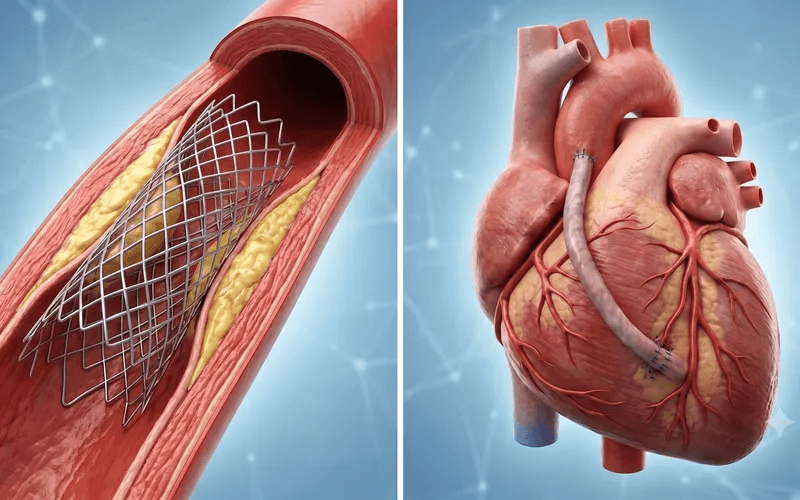
Angioplasty - properly called percutaneous coronary intervention (PCI) - opens a blocked artery from the inside. Through a small puncture in the wrist or groin, a cardiologist threads a thin catheter up to the blockage, inflates a tiny balloon to push the plaque aside, and leaves behind a stent (usually a drug-eluting stent) to hold the artery open. There's no chest incision. It's done under local anaesthesia with sedation, and most patients go home within a day.
Bypass surgery (CABG) takes the opposite approach: instead of clearing the blockage, we build a detour around it. I take a healthy blood vessel - most often the internal mammary artery from inside the chest wall, sometimes a vein from the leg or an artery from the forearm - and graft it so blood flows past the diseased segment entirely.
If you want the full step-by-step of the operation and recovery, I've explained it in detail in our guide to Coronary Artery Bypass Surgery (CABG).
| Feature | Angioplasty (PCI) | Bypass Surgery (CABG) |
|---|---|---|
| Approach | Opens blockage from inside | Reroutes blood around blockage |
| Invasiveness | Minimally invasive, via catheter | Open-heart surgery (usually) |
| Anaesthesia | Local + sedation | General |
| Hospital stay | 1-2 days | 6-7 days |
| Return to routine | ~1 week | 6-12 weeks |
| Best suited to | Simpler, fewer blockages; emergencies | Complex, multiple, or high-risk disease |
| Durability | May need a repeat procedure later | Often more durable, fewer repeats |
In my experience, angioplasty is often the right call when:
The appeal is obvious: minimal recovery, no chest scar, back to normal life in days.
For more complex disease, surgery usually gives better long-term results. I'll typically recommend CABG when there is:
Bypass asks more of you up front, but for the right heart it delivers more complete, longer-lasting relief.
In Mumbai I see so many patients with diabetes and multiple blockages. For them the evidence is clear - bypass usually offers better long-term protection than stents, and I'd rather have that conversation early than late.
Here's something I want every patient to know: this decision should never rest on a single doctor's preference. The modern standard - and what I insist on - is a Heart Team approach, where an interventional cardiologist and a cardiac surgeon review your angiogram together and agree on the recommendation best suited to your anatomy and risk. This protects you from a recommendation biased toward whichever specialty you happened to walk into first.
The factors we weigh together include the number, location and complexity of blockages; your age and overall health; whether you have diabetes, kidney disease or other conditions; your heart's pumping strength; and - importantly - your own priorities and lifestyle.
No patient should be steered toward a procedure simply because of which specialist's door they walked through first. That's why I insist on a joint Heart Team decision - it keeps the advice honest.
Every procedure carries some risk, and I'd rather you hear them from me than discover them later.
Angioplasty: re-narrowing of the artery (restenosis), a small risk of stent clotting, bleeding at the puncture site, and a period on blood-thinning medication (dual antiplatelet therapy) afterwards.
Bypass surgery: bleeding, infection, irregular heart rhythm (atrial fibrillation), a small stroke risk, and the general risks of major surgery and anaesthesia - traded off against greater durability.
In experienced hands and a well-equipped centre, both are very safe.
After angioplasty, most patients are up and about within a day and back to light routine within a week.
After bypass, recovery is more gradual: a few days in hospital, some weeks while the breastbone heals, and a structured cardiac rehabilitation programme. It's longer - but the improvement in chest pain and breathlessness is often dramatic and lasting.
Whichever path you take, the long-term result depends heavily on what happens after: controlling blood pressure, cholesterol and blood sugar, stopping smoking, staying active, and taking your medication. The procedure fixes the plumbing; your habits keep it working.
Angioplasty and bypass surgery aren't rivals - they're two tools for different problems. Angioplasty offers speed and minimal invasiveness for simpler blockages and emergencies. Bypass offers durability and completeness for complex, multivessel or high-risk disease. The best decision comes from a careful, personalised look at your own angiogram by an experienced team.
If you've been diagnosed with coronary artery disease and want a clear, unbiased second opinion, I'd be glad to help you understand your options. You can book a consultation with me or read more about my practice as a cardiac surgeon in Mumbai.
Is bypass surgery more dangerous than angioplasty? It's more invasive with a longer recovery, but it's very safe in experienced hands and often gives better long-term results for complex disease. Which is "safer" genuinely depends on your specific heart.
Can I just have angioplasty instead of bypass? Sometimes - especially for simpler blockages. But for left main disease, triple-vessel disease, or diabetes with multiple blockages, bypass is frequently the better long-term choice. Your angiogram decides.
How long do the results last? Bypass grafts - particularly arterial grafts - can last many years. Stents can also last a long time, though angioplasty carries a somewhat higher chance of needing a repeat procedure.
Which one is right for me? Only a proper evaluation - your angiogram, overall health, and ideally a Heart Team discussion - can answer that. Book a consultation for a personalized recommendation.
This article is for general education and awareness and is not a substitute for professional medical advice. Please consult a qualified cardiac specialist for guidance specific to your condition.

Dr. Amjad Shaikh reviews, corrects and approves every article published in his name. Read our editorial policy
Cardiovascular & Thoracic Surgeon
M.Ch (CVTS), M.S., FMAS (Fellowship in Minimal Access Surgery), MBBS
Dr. Amjad Shaikh is an experienced cardiac surgeon in Mumbai with over 15 years of experience, specialising in heart bypass surgery, beating-heart CABG, valve repair and replacement, minimally invasive cardiac surgery, and heart transplants. He has been involved in 5,000+ cardiac surgical cases, including complex, high-risk cases.