
Heart Bypass Surgery (CABG) in Mumbai: A Surgeon's Step-by-Step Guide
Beating heart bypass, LIMA-RIMA grafting, and total arterial bypass where suitable.

By Dr. Amjad Shaikh, M.Ch (CVTS)
Cardiovascular & Thoracic SurgeonLast reviewed 15 October 2026How we create our content
Overview
If you've just been told you need a heart bypass, you probably have more questions than answers right now. Let me explain it the way I do when a patient sits across from me in my clinic.
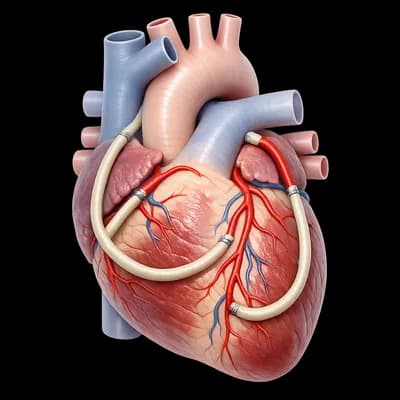
Coronary Artery Bypass Grafting — CABG, or simply “bypass” — does not clear a blocked artery from the inside. Instead, I take a healthy blood vessel from your own body and build a new road for blood to travel around the blockage and reach the heart muscle beyond it. For advanced coronary artery disease, this is still the most complete and durable fix we have. After fifteen years and more than 5,000 surgical cases, it remains the surgery I trust most for the right patient. If you'd like to know where that experience comes from — my training, the hospitals I operate at, and why I favour beating-heart and all-arterial grafts where they suit — my full background as a bypass surgeon in Mumbai is here.
In this guide I'll walk you through why bypass is done, how it actually works, the techniques we use today, what happens on the day of surgery, and what recovery really looks like — without the jargon.
Why Bypass Surgery Is Done
Your heart is a muscle, and like any muscle it needs its own steady blood supply. That job belongs to the coronary arteries. When plaque narrows or blocks them, the heart begins to starve — and that starvation is what you feel as chest pain, or angina. Left alone, it can tip into a heart attack, or worse, a cardiac arrest.
Bypass fixes this at the root. I carry blood past the blockage to the muscle waiting beyond it. Relieve the starvation, and the chest pain and breathlessness ease — and, just as importantly to me, the risk of a future heart attack drops.
The fear I hear most before surgery:
The most common fear before bypass surgery is death — patients ask me, ‘Will I survive this operation?' Their second fear is that they'll be stuck at home afterwards, of no use. That's simply not true — after recovery, my patients are active. They work, they exercise, they live fully, guided by our advice.
Who Actually Needs a Bypass?
Not every blockage lands on my operating table. Many are managed perfectly well with stents or medication. Bypass earns its place when the disease is widespread, or when it sits in the arteries that matter most. In practice, I recommend it when there is:
- More than two blockages, or all the major arteries affected — what we call triple-vessel disease
- A blockage in the left main artery, which feeds the largest share of the heart
- Multiple blockages in a younger patient, or a diabetic patient — where surgery protects the heart better over time than stenting does
How the Surgery Works
The map I'm working from
It helps to picture the heart's arteries. Two main vessels supply it — the left and the right. The left main quickly splits into the left anterior descending artery (the LAD, running down the front of the heart) and the circumflex (which curves around the side). The LAD sends off diagonal branches; the circumflex sends off obtuse marginal branches; and the right coronary artery covers the rest.
A blockage can sit anywhere along this map. When all three main arteries are badly narrowed — triple-vessel disease — that's the classic situation where bypass gives the best long-term result.
Watch: a real operation

LIMA–RIMA beating-heart bypass with four grafts.
Why the choice of graft matters so much
A “graft” is simply the new vessel I use to reroute the blood. There are two families to choose from, and picking the right one is one of the most important decisions I make in the whole operation.
Arterial grafts are the ones I reach for first, because they stay open the longest. The workhorses here are the LIMA (Left Internal Mammary Artery) and RIMA (Right Internal Mammary Artery) from inside the chest wall — often around 20 to 25 years — and, when the blood supply to the hand allows it, the radial artery from the forearm. There's something elegant about these vessels: they naturally resist the very plaque that blocks everything else.
Vein grafts — usually the saphenous vein from the leg — are dependable and versatile, but I use them selectively. They just don't last quite as long, typically around 10 to 15 years.
Supporting evidence: In a study of 2,127 arterial grafts, left internal thoracic artery grafts were open in about 96% overall and in 88% at 15 years, and right internal thoracic artery grafts in 65% at 15 years (Tatoulis et al., Ann Thorac Surg 2004); Loop et al. (NEJM 1986) found better 10-year survival with a mammary-artery graft than with vein grafts alone — Tatoulis 2004 (Ann Thorac Surg) and Loop 1986 (NEJM)
Why I prefer off-pump surgery and arterial grafts:
Off-pump surgery avoids the heart-lung machine, and with it the risks of stroke, infection, and multiple blood transfusions — it's quicker, and done on a beating heart. As for grafts: a vein lasts approx. 10 to 15 years, but the LIMA and RIMA arteries work for approx. 20 to 25 years. That's why total arterial grafting with LIMA-RIMA is my preferred approach — though how long any graft lasts also depends on the patient's lifestyle after surgery: controlling diabetes, blood pressure, and cholesterol, staying active, and avoiding tobacco.
One graft, or five?
It depends entirely on how many vessels are blocked. A single blockage at the start of the LAD may need just one graft. When several arteries are involved, I do all the grafts in the same operation — four or five in one sitting is common when the disease is widespread.
Bypass and Diabetes: Why This Matters So Much in Mumbai
I'll be honest about something I see almost every week in my practice. Diabetes is common among my patients here, and it rarely blocks just one artery politely — it tends to cause multiple, diffuse blockages throughout the coronary tree. For these patients, the evidence and my own experience point the same way: bypass usually protects the heart better than stenting.
Supporting evidence: In the FREEDOM trial and its long-term follow-on study (Farkouh et al., J Am Coll Cardiol 2019), people with diabetes and multivessel disease had significantly better long-term survival with bypass surgery than with drug-eluting stents — FREEDOM Follow-On 2019 (JACC)
How diabetes shapes my approach:
Diabetes is one of the most important causes of coronary disease, and it tends to cause multiple, diffuse blockages. I control the patient's diabetes precisely before and after surgery — keeping HbA1c around 7 — because good control slows the build-up of new blockages and cholesterol deposits. In a diabetic with multiple blockages, I prefer bypass with multiple grafts; putting in multiple stents is not a good idea.
Bypass or Angioplasty (Stents)?
Patients often arrive expecting me to argue for surgery. I don't. Bypass and angioplasty aren't rivals — they're two tools for two different problems. A stent is excellent for one or two discrete blockages, and it's often the fastest way to open an artery during a heart attack. But when the disease is spread across three vessels, or sits in the left main, bypass gives more complete and longer-lasting relief. That's the honest distinction I draw for every patient.
The Different Types of Bypass
On-pump (traditional). A heart-lung machine takes over while the heart is stopped, and I do the bypass on a still heart. It served us well for decades, and still has its place in certain cases.
Off-pump (beating-heart). My preferred approach for most patients. No heart-lung machine — the heart keeps beating while a stabiliser holds steady just the small patch I'm working on. Skipping the machine avoids a whole set of its complications, from stroke to infection.
Supporting evidence: In the CORONARY trial (4,752 patients; Lamy et al., NEJM 2016), five-year clinical outcomes were similar between off-pump and on-pump CABG. Off-pump surgery avoids the heart-lung machine, but the most appropriate technique depends on patient factors and the surgeon's assessment — CORONARY 5-year 2016 (NEJM)
Minimally invasive. Here I reach the heart through a small cut on the side of the chest, without dividing the breastbone at all. Recovery is faster and the scar is smaller — though not every set of blockages suits this approach.
Emerging techniques. Robotic-assisted bypass, through keyhole incisions, is an advancing field aiming for even greater precision and quicker recovery as the technology and training mature.
What Happens, Step by Step
Before surgery
Preparation begins about four days ahead. We stop blood thinners four days before to reduce bleeding, run a full set of blood tests, and start you on an antiseptic soap to lower infection risk. You're admitted the day before the operation — up to then, you carry on with your normal routine.
Anaesthesia
You're fully asleep under general anaesthesia and feel nothing throughout. We place fine monitoring lines to watch your heart and blood pressure every second of the operation.
Taking the grafts
I harvest the grafts — the internal mammary arteries, a leg vein, or the radial artery — based on your age and whether you're diabetic. In younger patients, I often go for total arterial grafting with the LIMA and RIMA, for the durability it buys them.
A worry patients almost always have about this:
Patients worry that taking a vein from the leg or an artery from the arm will harm them. It doesn't. The leg has many other veins to compensate — there may be mild swelling for a month or two, nothing to worry about. Before taking the radial artery, we first confirm the ulnar artery supplies the hand well; only then do we use it. And with the LIMA, the right internal mammary artery keeps the supply intact. The body manages perfectly.
Placing the grafts
I do most of this on the beating heart, using a stabiliser we nickname the “octopus” to steady just the small section I'm stitching. Each graft is joined beyond the blockage, and blood flows freely to that part of the muscle again.
Closing up
Once the grafts are done, I close the breastbone with sternal wires. Chest drains are usually removed within one to two days, and you're watched closely in the ICU for one to two days. Most patients are off the ventilator the same day or the next — and, to many families' surprise, up and walking within the first two to three days.
Supporting evidence: NHS patient guidance describes chest drains being removed after 1 or 2 days, and a move from intensive care to the ward after 1 or 2 days — How a coronary artery bypass graft is done (NHS) and Recovering from a coronary artery bypass graft (NHS)
How Bypass Has Changed
This is not the operation it was when I started. The field keeps moving — more arterial grafts for longer-lasting results, hybrid procedures that pair bypass with a stent, steadily better minimally invasive techniques, and now the early role of robotics.
What's changed in fifteen years:
In my 15 years, bypass surgery has changed enormously. We moved from on-pump to off-pump, beating-heart surgery. We shifted from using mostly vein grafts to using the LIMA and RIMA arteries, because they last far longer. And instead of opening the chest, we now do minimally invasive, keyhole surgery without cutting the breastbone — each step making recovery faster and safer for patients.
Recovery: What to Really Expect
In hospital
Most patients go home in six to seven days. Once the drains are out and you're walking comfortably, you're ready. I'll ask you to stay active at home, and to wear a chest support belt for about 45 days while the breastbone knits.
Pain and wounds
Kidney-safe painkillers cover the first week, and the pain usually settles a lot after the first couple of days. Wound problems are uncommon. Even when I take both mammary arteries, breastbone healing problems occur in fewer than 1% of patients whose diabetes isn't well controlled, because the chest wall has a good collateral blood supply. That's exactly why I'm so strict about blood sugar.
Getting back to life
Everyday activities usually resume gradually, often after about two to three weeks, and desk-based work is possible at around four to six weeks, depending on your recovery and your surgeon's clearance.
The mistake I see families make most:
The most common mistake I see is families keeping the patient confined to bed, not letting them walk or talk — thinking they're protecting them. It harms both mind and body. Patients need to know their life will be good after surgery, and they need to stay mobile to rebuild physical strength. I always ask families to encourage movement and follow our advice.
If it was minimally invasive CABG
When I can do the bypass without dividing the breastbone, recovery is noticeably quicker — less pain, a smaller scar, one to two days in the ICU and one to two on the ward, and routine activities, including driving and going out, back within about 15 days. There's no long cut in the chest either. Not everyone is a candidate; it depends on the pattern of blockages, comorbidities and my assessment.
When to call us
Ring your surgeon promptly if you feel very weak, giddy, or have chest pain coming back during recovery. Don't wait it out.
Recovery Roadmap: Open vs. Minimally Invasive
The section above is the “what”; this table is the “when.” It's a general guide — I tailor it to each patient, and no two people heal at quite the same pace.
The Risks — Honestly
Every operation carries some risk, and I'd rather you hear them from me. The usual ones are infection, bleeding, an irregular rhythm (atrial fibrillation), and a small stroke risk. In experienced hands and a well-equipped centre, the chance of a serious complication is low. And doing the bypass on a beating heart, without the heart-lung machine, sidesteps many of the complications people used to associate with this surgery.
Bypass vs. Other Options
Versus angioplasty. One or two blockages? Often a stent is the answer. But more than three, or left main disease, or a critical blockage right at the start of an artery — that's where bypass is the more durable choice.
Versus medication alone. Medicines have their place — for very elderly patients, those unfit for surgery, or those with serious other illnesses. They ease symptoms, but they don't cure advanced blockages.
Life After Bypass
Here's the part patients underestimate: the surgery is only half the story. I can build you perfect grafts, but what you do afterwards decides how long they last. A daily 30-minute walk is one of the best things you can do. Go easy on deep-fried food and red meat. If you're diabetic, keep that sugar tight.
The good news is that most of my patients need few medicines afterwards, with a check-up every six months. The strongest protection against new blockages isn't in my hands at that point — it's in yours: staying active, controlling diabetes, and staying away from tobacco completely.
What Affects the Cost in Mumbai
The cost of treatment is not one fixed figure. It depends on you, on the treatment you need and on where you are treated. The main factors are:
- Hospital category. Charges differ between hospitals, for example between a large multi-speciality hospital and a smaller centre.
- Room type. A general ward, a semi-private room, a private room and a suite are charged differently, and so is time in intensive care.
- The graft, valve, device or implant used. The type used in your treatment can change the cost, for example the grafts used in bypass surgery, the valve chosen in valve surgery and TAVI, or the stent-graft used in some aortic repairs.
- Your condition and the treatment you need. A single planned treatment and a combined or more complex one are not priced alike.
- Length of hospital stay. A longer stay adds to the total.
- Tests and medicines. Investigations and medicines before, during and after the stay add to the total.
- Insurance and cashless admission. Whether your policy covers the procedure, what limits it sets, and whether the hospital offers cashless admission with your insurer, all affect what you pay yourself.
Because these factors are specific to each patient, a fair estimate is only possible after an evaluation, so no figure is given on this page. Ask the hospital for an itemised estimate before admission, and check with your insurer what your policy covers.
Frequently Asked Questions
Common clinical queries regarding the procedure and recovery.
Usually 3 to 4 hours, depending on the number of grafts and how complex your anatomy is.
There's mild pain for the first two to three days, and then it settles quickly.
Around two to three weeks for open surgery, and about 15 days if it's done minimally invasively.
It lasts many years — as long as you keep a healthy lifestyle and control your risk factors.
Graft life varies: LIMA and RIMA grafts work for approximately 20 to 25 years, and vein grafts about 10 to 15 years. How long they last also depends on your lifestyle — diabetes, blood pressure, cholesterol, and tobacco all matter.
Every six months.
Light walking within days; driving after 4 to 6 weeks; desk-based work after 4 to 6 weeks and physically demanding work after around 8 weeks or longer; and strenuous activity after 3 to 6 months, on my advice. Always discuss with your surgeon before resuming any new heavy activities after surgery.
Disclaimer: This guide is for general education and awareness and is not a substitute for professional medical advice. Please consult a qualified cardiac surgeon for guidance specific to your condition. If you'd like an expert opinion, you can consult Dr. Amjad Shaikh, a cardiac surgeon in Mumbai.
Need a second opinion before Heart Bypass Surgery?

Dr. Amjad Shaikh reviews, corrects and approves every article published in his name. Read our editorial policy
Dr. Amjad Shaikh
Cardiovascular & Thoracic Surgeon
M.Ch (CVTS), M.S., FMAS (Fellowship in Minimal Access Surgery), MBBS
Dr. Amjad Shaikh is an experienced cardiac surgeon in Mumbai with over 15 years of experience, specialising in heart bypass surgery, beating-heart CABG, valve repair and replacement, minimally invasive cardiac surgery, and heart transplants. He has been involved in 5,000+ cardiac surgical cases, including complex, high-risk cases.