Varicose Veins Laser Treatment (EVLT) in Mumbai — by a Cardiovascular Surgeon
Advanced treatment for varicose veins with effective relief & faster recovery.
By Dr. Amjad Shaikh, M.Ch (CVTS)
Cardiovascular & Thoracic SurgeonLast reviewed 15 October 2026How we create our content
Overview
Patients often come to me embarrassed about their varicose veins, treating them as just a cosmetic nuisance. And sometimes they are only that. But those bulging, twisting veins are also a signal — a sign that the valves inside your leg veins have stopped doing their job. My approach is to look past the veins you can see, find where the real problem lies, and fix it at the source.
Here's the simple version of why they form. Your leg veins carry blood back up to the heart, working against gravity, with tiny one-way valves acting as doors that stop it draining back down. When those valves weaken and fail, blood leaks backwards and pools — and the vein swells, bulges, and twists into what you see on the surface.
Why See a Vascular Surgeon for Varicose Veins?
Laser treatment for varicose veins is offered by several kinds of specialists these days. What I bring as a cardiovascular surgeon is that veins are my core expertise — I manage the whole venous problem, not just perform one procedure. That matters for you in three ways:
- The right diagnosis. I assess the entire venous system, including a detailed ultrasound map of exactly where the valves are failing, so the treatment addresses the true source — not just the veins you can see.
- The full range of treatments. If laser is the best choice, that's what you get. But if a vein needs a different approach, or the disease is more advanced, I can offer the complete spectrum of treatments under one roof.
- Expertise for complex cases. Advanced disease — with skin changes, ulcers, or recurrence after a previous treatment — is exactly the kind of case I'm trained to manage.
What Causes Varicose Veins?
Most often they develop with age, as the vein valves gradually weaken and let blood flow backwards. Pregnancy is another common trigger — the growing uterus presses on the veins and hormones play a part; in most women these improve on their own within three to twelve months after delivery. Standing for long hours, a family history, and carrying extra weight all add to the risk too.
The Symptoms to Watch For
Varicose veins range from a purely cosmetic worry to a genuine source of discomfort. Common signs include:
- Veins that look blue or purple
- Veins that bulge or twist
- Aching legs, muscle cramps, and itching around the veins
- Less commonly, bleeding or hardening of the veins, skin discolouration, inflammation, or leg ulcers
How I Diagnose Them
This is where a proper vascular assessment earns its keep. Beyond looking at the visible veins, I use a venous duplex ultrasound to map the blood flow through your leg and pinpoint exactly which valves are leaking — a problem we call venous reflux. That map is what lets me plan a precise treatment aimed at the source of the reflux, not just the surface veins. Treating the source is the whole secret to a lasting result and a low chance of the veins coming back.
When Is Treatment Needed?
Mild varicose veins can often be managed simply — regular exercise, a healthy weight, and compression stockings. I recommend active treatment when those steps no longer ease the symptoms, when the discomfort is getting worse, or when complications like skin changes or ulcers start to appear.
Treatment Options
Because I offer the full range, I can match the treatment to your veins rather than the other way around. Endovenous laser (EVLT) is the most widely used modern option, and depending on the case I may combine it with, or choose instead, other approaches — removing surface veins through tiny incisions, or injection treatments for smaller veins.
Endovenous Laser Treatment (EVLT), Step by Step
What the laser actually does
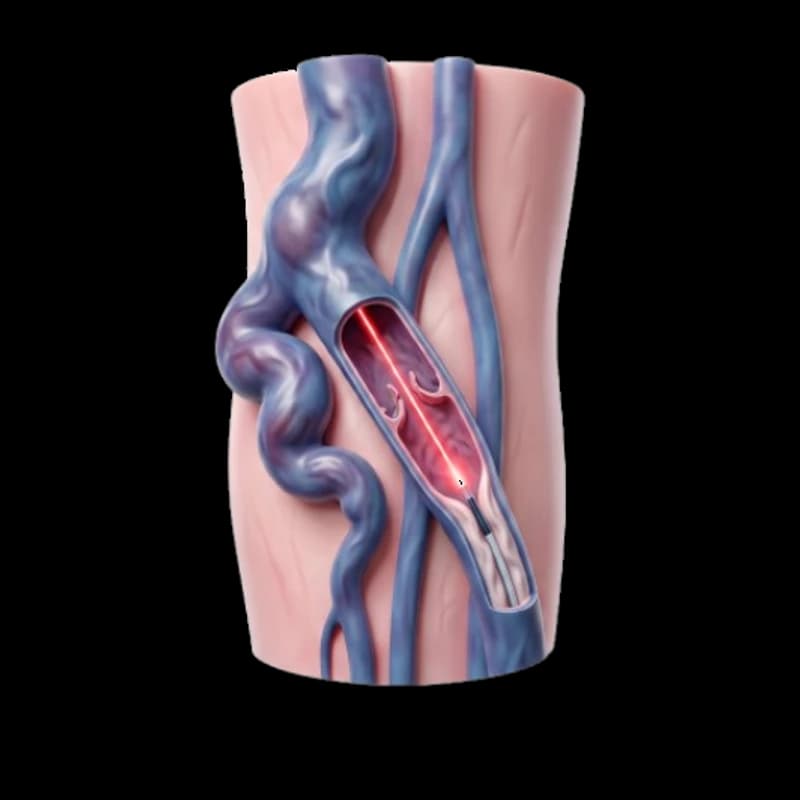
A laser is simply light energy in a highly concentrated form. In EVLT, I deliver that energy in a very precise, controlled way to the inside of the faulty vein. The vein reacts to the light energy by closing and sealing itself shut — quietly taking that leaking vein out of circulation.
How I perform it
EVLT is a day-care, out-patient procedure — no hospital stay. I work through a tiny cut in the leg under local anaesthesia to numb the area, then pass a thin laser fibre into the damaged vein. As I slowly withdraw the fibre, it delivers exactly the right amount of energy to seal the vein along its length. I use a modern jacketed fibre, which keeps the fibre from touching the vein wall directly — that means noticeably less bruising and discomfort for you.
Supporting evidence: In a five-year randomised trial of 798 patients (Brittenden et al., NEJM 2019), disease-specific quality of life was better after endovenous laser ablation or surgery than after foam sclerotherapy, and endovenous laser ablation was the most cost-effective of the three — Varicose vein treatments, 5-year RCT (NEJM 2019)
Recovery After Laser Treatment
The most common worry I hear is: if you close a vein off, where does the blood go? It's a fair question, and the answer is reassuring.
So you're asked to walk immediately and can get back to day-to-day life the same day. Depending on how many veins are involved, treatment may be done over a few sessions. A small number of patients feel some temporary soreness or mild swelling, which settles within about four to five days and is easily eased with simple medication.
The Benefits of Laser Treatment
For most patients, EVLT has clear advantages over old-style vein surgery: no hospital stay, only a tiny incision, treatment under local anaesthesia, minimal scarring, little discomfort, and an immediate return to walking and daily life. And because it seals the faulty vein right at its source, it gives reliable, long-lasting relief with a low chance of recurrence — provided the underlying reflux has been properly found and treated.
The Risks, Honestly
EVLT is safe and well established, and serious complications are uncommon. Some patients get temporary bruising, soreness, mild swelling, or a feeling of tightness along the treated vein, which usually settles quickly. As with any vein procedure, there are small risks such as temporary numbness or, rarely, a clot — which is exactly why I believe this is best done by a vascular surgeon who can assess the whole venous system and manage any complication that arises.
Caring for Your Legs and Preventing Recurrence
Treated or not, a few simple habits keep leg veins healthy: stay active and walk regularly, keep a healthy weight, avoid long stretches of standing or sitting without moving, put your legs up when resting, and wear compression stockings if I've advised them. These reduce symptoms and lower the chance of new varicose veins forming.
What Affects the Cost in Mumbai
The cost of treatment is not one fixed figure. It depends on you, on the treatment you need and on where you are treated. The main factors are:
- Hospital category. Charges differ between hospitals, for example between a large multi-speciality hospital and a smaller centre.
- Room type. A general ward, a semi-private room, a private room and a suite are charged differently, and so is time in intensive care.
- The graft, valve, device or implant used. The type used in your treatment can change the cost, for example the grafts used in bypass surgery, the valve chosen in valve surgery and TAVI, or the stent-graft used in some aortic repairs.
- Your condition and the treatment you need. A single planned treatment and a combined or more complex one are not priced alike.
- Length of hospital stay. A longer stay adds to the total.
- Tests and medicines. Investigations and medicines before, during and after the stay add to the total.
- Insurance and cashless admission. Whether your policy covers the procedure, what limits it sets, and whether the hospital offers cashless admission with your insurer, all affect what you pay yourself.
Because these factors are specific to each patient, a fair estimate is only possible after an evaluation, so no figure is given on this page. Ask the hospital for an itemised estimate before admission, and check with your insurer what your policy covers.
Frequently Asked Questions
Common clinical queries regarding the procedure and recovery.
It's generally well tolerated — done under local anaesthesia as day care, with modern jacketed fibres that reduce bruising. Most patients walk the same day.
No — EVLT is an out-patient, day-care procedure. You can usually go home and resume normal activities the same day.
The treated veins are superficial and carry less than five percent of the body's blood. The body automatically reroutes the flow through the healthy deep veins.
Right away — I ask patients to walk immediately and resume day-to-day activities the same day, with only mild, temporary soreness in some cases.
When the underlying reflux is properly diagnosed and treated at its source, recurrence is uncommon. Healthy habits reduce the risk further.
A vascular surgeon specialises in the whole venous system — diagnosing the true source, offering the full range of treatments, and managing advanced or complex cases and any complication.
Disclaimer: This guide is for general education and awareness and is not a substitute for professional medical advice. Please consult a qualified cardiac surgeon for guidance specific to your condition. If you'd like an expert opinion, you can consult Dr. Amjad Shaikh, a cardiac surgeon in Mumbai.
Need a second opinion before Vascular Surgery
Dr. Amjad Shaikh reviews, corrects and approves every article published in his name. Read our editorial policy
Dr. Amjad Shaikh
Cardiovascular & Thoracic Surgeon
M.Ch (CVTS), M.S., FMAS (Fellowship in Minimal Access Surgery), MBBS
Dr. Amjad Shaikh is an experienced cardiac surgeon in Mumbai with over 15 years of experience, specialising in heart bypass surgery, beating-heart CABG, valve repair and replacement, minimally invasive cardiac surgery, and heart transplants. He has been involved in 5,000+ cardiac surgical cases, including complex, high-risk cases.